Order On-Line Site Map Search

HeartStrings FiberArts
Inspiration & Patterns for Wearable Art in Timeless Styles

What's New Locate a Retailer Wholesale Portal Resources As Seen In About
Lace Scarves/Stoles
Beaded Scarves
Faroese Shawls
Other Shawls
Sweaters and Vests
Socks & Sock-Nots
Wrist Warmers
Neck & Up
For the Man
Other Goodies
Holidays/Seasonal
Comfort Collection
A Year of Socks
I Hate to Purl
PDF Catalog & Flyers
Patterns by Yarn Weight
Beaded Patterns Only
Tips to Tutorials


Subscribe to Free Newsletter
Get a Thank You Gift
Privacy Statement

Your thank you donation, small or large, is very much appreciated. Money will be used to continue to bring you free educational resources and newsletters.


Where is Jackie?
Visit My Blog
Jackie ES on Ravelry
Follow me on Follow JackieErickson on Twitter

"I just love the simplicity of your patterns and the complexity of their appearance."
- Maureen M.
"I enjoy your website. It is easy to use and full of information, just as I would expect it to be."
- Debby L.
"Your patterns are just fabulous ... unique and yet based on tradition."
- Jennifer C.

"I just read the Color mini-tutorial and although I have taken several color classes at conferences, you added new ways of looking at color mixtures. My mantra is "Color is Everything" so I am thrilled to think about it in more ways now."
- Bara

"Lever-action" Knitting

Just one of many knitting methods

My primary knitting method is an English style, but with some differences from what you may have seen in other knitters using this style. There are many, many ways to knit, and even variations within them, so this is not an endorsement of the way I knit. I am describing here, only because so many people have asked. If you are looking to add to, change or refine your repertoire of knitting methods, I hope you find these ideas helpful.

Overview

The basic premise is that motion is minimized. Less wasted motion means quicker knitting. Also, a side benefit is the reduction of risk for repetitive motion stress ailments, like carpal tunnel syndrome.

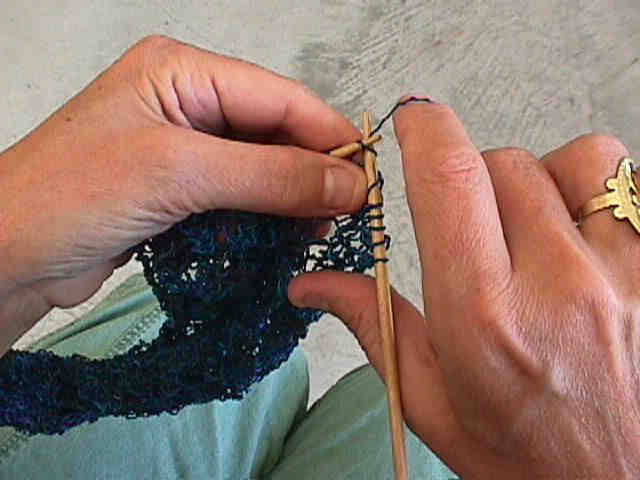
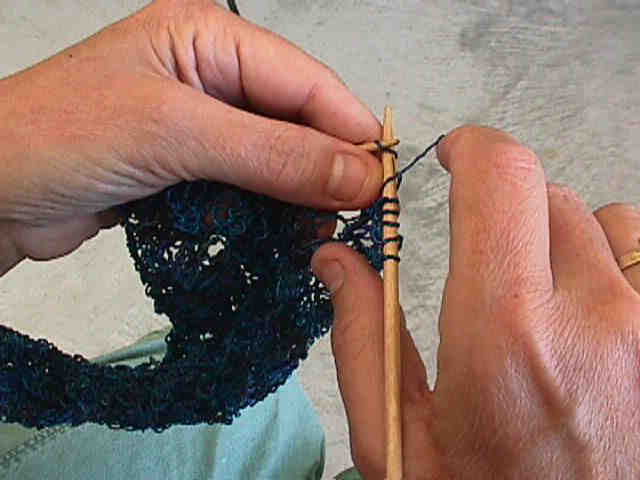
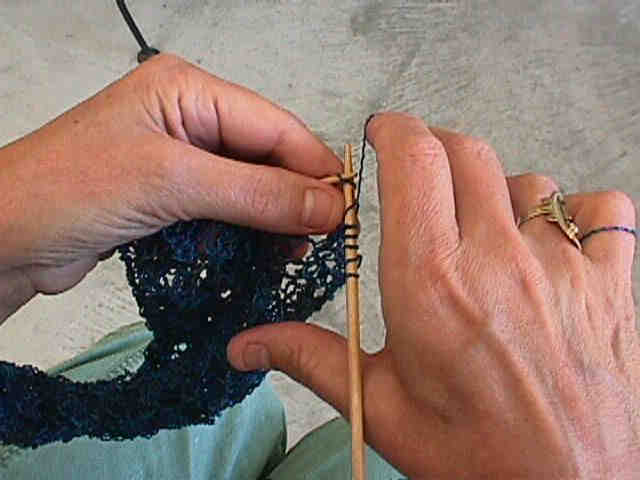
In the English style of knitting, the yarn is held in the right hand. The technique of getting the yarn around the needle point to form the next stitch is usually referred to as "throwing". In order to accomplish this, many knitters move their entire hand to bring the yarn to and around the needle point. An alternative is to use the index finger like a "lever", and extend outward to bring the yarn to the needle point, then flex slightly sideways and inwards to wrap the yarn around the needle point. Here are thumbnail pictures of the sequence. A fuller explanation, and enlarged pictures are available below. Note: Pictures open in separate window.

Beginning position
Starting position
Flex outwards
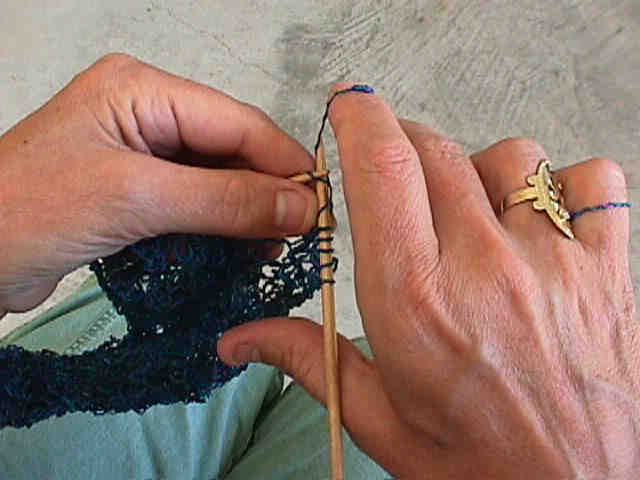
Flex outwards
Flex sideways/catch needle point
Catch needle point
Wrap around point
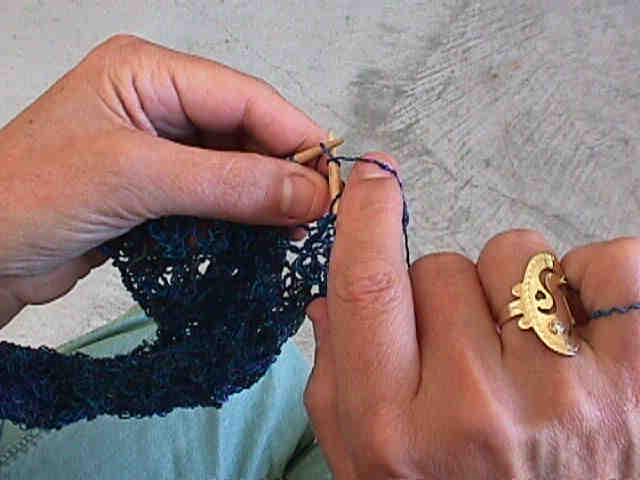
Wrap around point
Bring stitch through
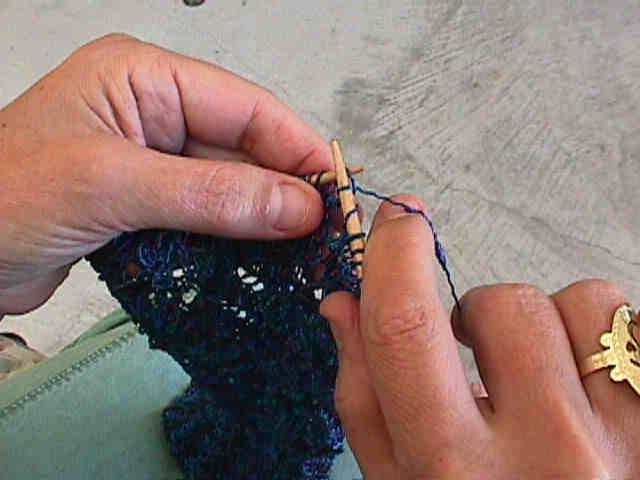
Form new stitch
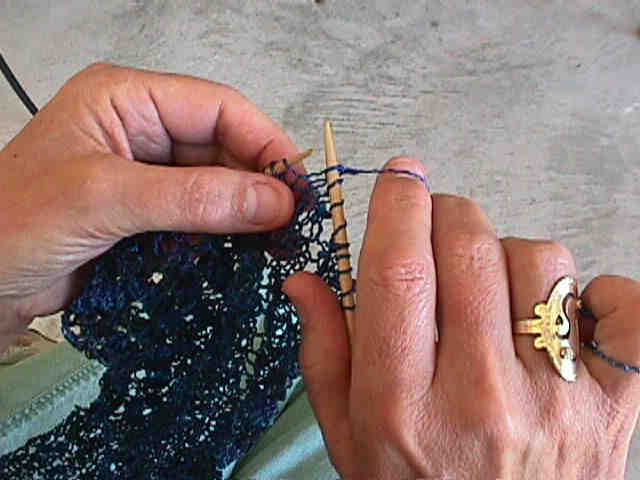
Form new stitch
Take new stitch off
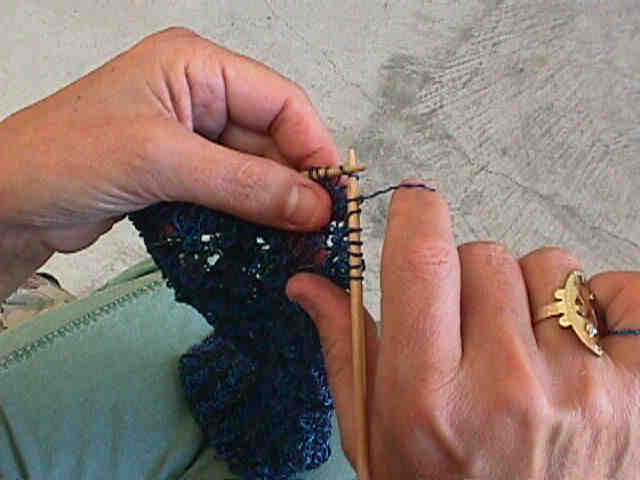
Take new stitch off
Ready to begin next stitch

The photos are also available as an animated sequence prepared by Elaine Norris.

As a comparison, in the Continental, or German style of knitting, the yarn is held in the left hand, and the yarn is "picked" or scooped up by the right-hand needle point. The Continental method reminds me of crocheting, and it is quite natural to me as well. There likewise are efficiency tips that can be applied to this style of knitting by eliminating wasted motion, such as keeping your yarn tensioned close to the needle points.

A more detailed explanation of the "lever-action" style of English knitting - with enlarged pictures

  1. Tension yarn across/around fingers in right hand the way you would normally, except make sure that yarn passes across tipmost joint of your index finger (the one next to your thumb). Note: I am a vicious nail-biter, which will be very apparent in these pictures. It has been a particularly stressful week at my "real" job, and the nails have definitely taken their toll. You just don't know what a sacrifice I am making to let you see this embarrassment, but I know several of you are anxiously awaiting these pics!
  2. Support right-hand knitting needle in some way. Since I generally use circular knitting needles, or short straight or double pointed needles, I support the needle with my right thumb. For this type of support, my thumb is under the right-hand needle as shown here If using long straight needles, I could support the needle under my arm, or in a knitting belt, and just let my thumb stay relaxed above the knitting.

    To begin with, the right index finger is flexed toward you, and your hands are positioned close to the needle tips, as pictured here. The pictures show a knit stitch being made, i.e. the working yarn is held in back of the right needle, and the right needle tip inserted from left to right into the front loop of the stitch on the left needle.
  3. Flex the index finger with the yarn outward, then slightly sideways to the left and catching the tip of the right hand needle, and complete the counter-clockwise movement around the tip. Then retract the index finger back again toward your hand.

    This sequence of steps is the "lever action" I was referring to.
  4. Proceed as usual, forming the new stitch on the right hand needle by bringing the wrapped yarn through the old stitch, and removing the old stitch from the left needle.

Repeat these steps for each stitch.

The lever action is accomplished in a similar way for a purl stitch, the difference of course being that the working yarn is held to begin with in front of the right needle, and the right needle tip is inserted from right to left into the front loop of the stitch on the left needle.


Animation

The picture sequence can also be viewed in another window as an animated gif. Thanks to Elaine Norris for preparing this animation from the original photos.


Mary Helen writes ...
I am a slow knitter and was perusing the internet to find ways to improve. It was a zig-zag path that led me to your site, and I am so grateful to learn your lever-action method. My technique is similar but i 'throw' more than I now know is necessary. I learn best by seeing something demonstrated and appreciate your thorough visual for this method. Thank you so much!

Return to Index of Jackie E-S Articles & Tips.

HeartStrings FiberArts is a wholesale pattern company. I encourage individuals to visit your local yarn store or check the Store Locator to purchase hard-copy patterns and downloadable e-patterns. If you don't already have a favorite retailer from whom to buy, you can use the HeartStrings online catalog at Shopatron. This service will find a retailer with the patterns you want in stock to mail to you right away.

Questions? Comments? - I love to hear from you, whether it be to get advice about your HeartStrings knitting projects, to make suggestions, or to share news of your accomplishments. Kind regards, Jackie E-S

Email address: jackie@heartstringsfiberarts.com
On-line wholesale orders: http://www.heartstringsfiberarts/wholesaleorder.shtm
Wholesale orders by phone or fax: 1-888-955-8094 (toll-free outside New Orleans area) or 985-764-8094
Direct line for chats or advice: 985-764-8094
Postal address: HeartStrings, Jackie Erickson-Schweitzer, 53 Parlange Drive, Destrehan LA 70047-2133 USA

Company
Meet Jackie E-S
What's New
As Seen In
e-Newsletter
Class/Exhibit Schedule
Privacy Statement
Design Gallery
Lace Scarves/Stoles
Beaded Scarves
Faroese Shawls
Triangle Shawls
Lace Sweaters
Casual Wear
Socks & Sock-Nots
Wrist Warmers
Neck & Up Coverings
Other Goodies
Holidays
Comfort Collection
Sock Journal
I Hate to Purl Collection
Beaded Patterns Only
Featured Yarns
Buy Patterns
Where to Buy
On-line Retail Orders
Downloadable Patterns
Wholesale Orders
Retailers Only
Wholesale Terms
Dealer Application
Support Services
Wholesale Ordering
Classes
Tutorials
Travel Teaching
Online Classes

Mini-Tutorials
Playing with Color
Using a Swift
Wraps per Inch
What is Blooming?
To Seam or Not?
Dealing with Ends?
The Lifeline
Blocking in Progress
Blocking Tips
Repairing a Disaster
Lever-Action Knitting
3R's of Knitting
Resources
Catalogs and Flyers
Newsletter Archive
Jackie E-S Blog
Articles & Tips
Link Banners
Pattern Index
Errata
Site Map
Search Site

Last revised Sunday, 23-Dec-2007 09:27:49 CST